
For Derby Day
And the thoroughbred

The eye can hardly pick them out
From the cold shade they shelter in,
Till wind distresses tail and main;
Then one crops grass, and moves about
– The other seeming to look on –
And stands anonymous again
Yet fifteen years ago, perhaps
Two dozen distances sufficed
To fable them: faint afternoons
Of Cups and Stakes and Handicaps,
Whereby their names were artificed
To inlay faded, classic Junes –
Silks at the start: against the sky
Numbers and parasols: outside,
Squadrons of empty cars, and heat,
And littered grass: then the long cry
Hanging unhushed till it subside
To stop-press columns on the street.
Do memories plague their ears like flies?
They shake their heads. Dusk brims the shadows.
Summer by summer all stole away,
The starting-gates, the crowd and cries –
All but the unmolesting meadows.
Almanacked, their names live; they
Have slipped their names, and stand at ease,
Or gallop for what must be joy,
And not a fieldglass sees them home,
Or curious stop-watch prophesies:
Only the grooms, and the grooms boy,
With bridles in the evening come.
I wanted to do a voiceover for this piece, which is written for tomorrow’s Derby Day at Epsom.
But I choked up every time with the poem (Larkin’s At Grass of course) so that was that; I love it so deeply that I can scarcely read it on the page, in love as I am with the thoroughbred horse, and in particular with the one pictured below: bequeathed to us by my father and ‘fabled’ in a small way, by winning seven races and leaving the churn of his hoofprints on Newmarket’s mythical heath.
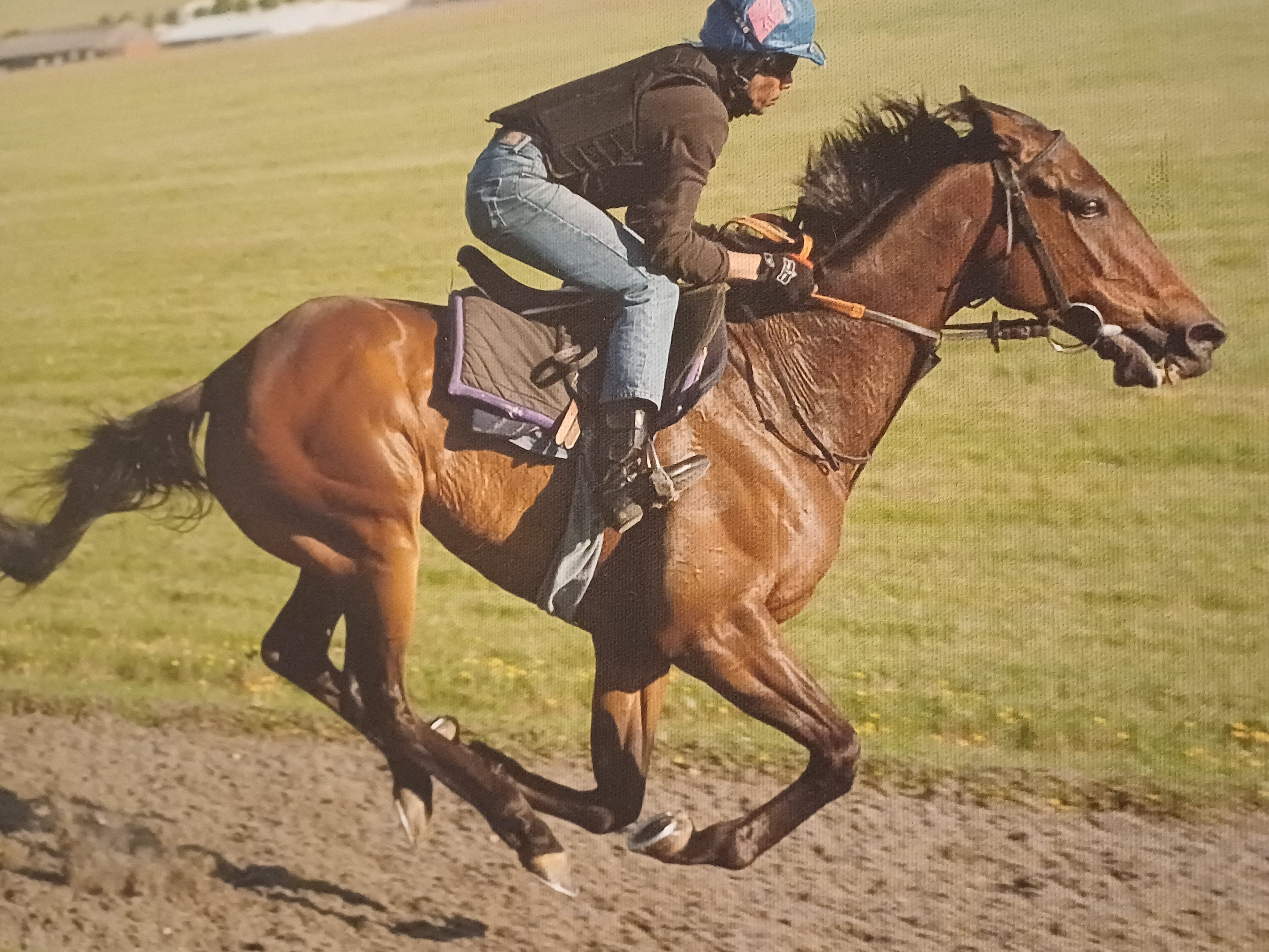
And who, now, has slipped his name - ‘After the Show’ has become, simply, Arthur - to live with his band of adoring mares (none more than me; not a great pic but you can see the worship) on a friend’s stud.
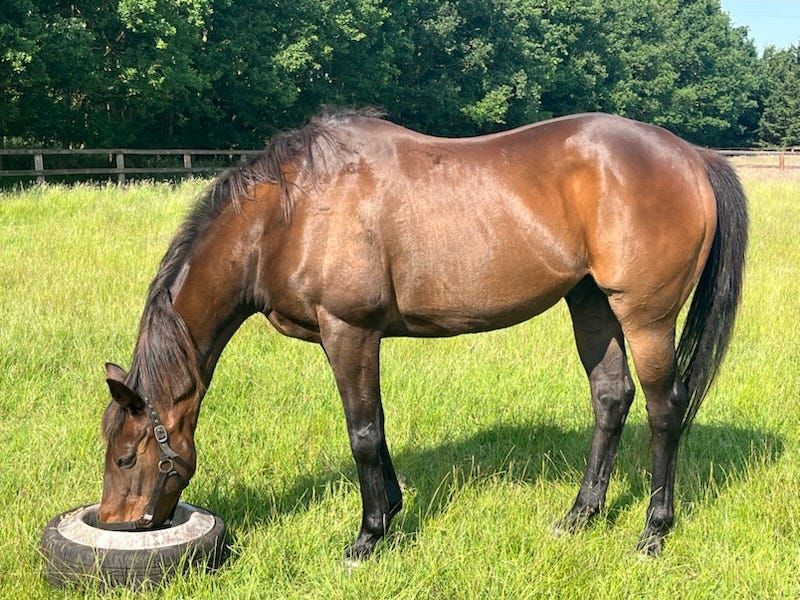
And ‘at grass’ (ie noshing his venerable head off):
To have this horse in my life is like no other feeling. I hardly ever go racing: scattergun modernization has wrecked so much of the experience for those who, like myself, are semi-despised as ‘traditionalists’’ (but what is racing without tradition), and I find it increasingly hard to watch even races on the flat (can’t say too often how much I loathe jumping): the emotion of it is just too great. But without racing there would be no thoroughbred, and that for me is untenable. I spend a lot of time in Newmarket, and the associated sense of privilege never lessens. Newmarket, whose destiny was shaped by the immense heath - perfect equine turf - that surrounds this ordinary little town, is not really a beautiful place; frankly it is above all that; but it has a sense of purpose - more precious nowadays than beauty - which is unbroken and unchanged for more than three hundred years. It is the home of the thoroughbred. In the veiled enchanted mornings they take possession of the place: they gallop up Warren Hill, from whose summit Charles II would watch as they thundered steamily towards him; they traverse the roads on special horse crossings, where self-regarding places-to-go twits, who would happily brush the toecaps of doddering jaywalkers, wait obediently in their Audi Q8 SUVs and relish the comradely nods of work riders; they form smooth Stubbsian groups in paddocks. I have inhabited these scenes since the start of the century and they get no less magical, partly because they are so much of the everyday - nobody in Newmarket is trying to create magic; it is a very laconic place - but really because of the thoroughbred. Their enigmatic translucent eyes. The depth that is in them. The oddity of our relationship with them, whereby they can be owned and controlled up to a point, yet remain essentially unknowable. They are a man-made construct, in that their breeding lines are pure streams forged in quest of perfection, but what was let loose in their creation is so much more: fundamentally they elude.
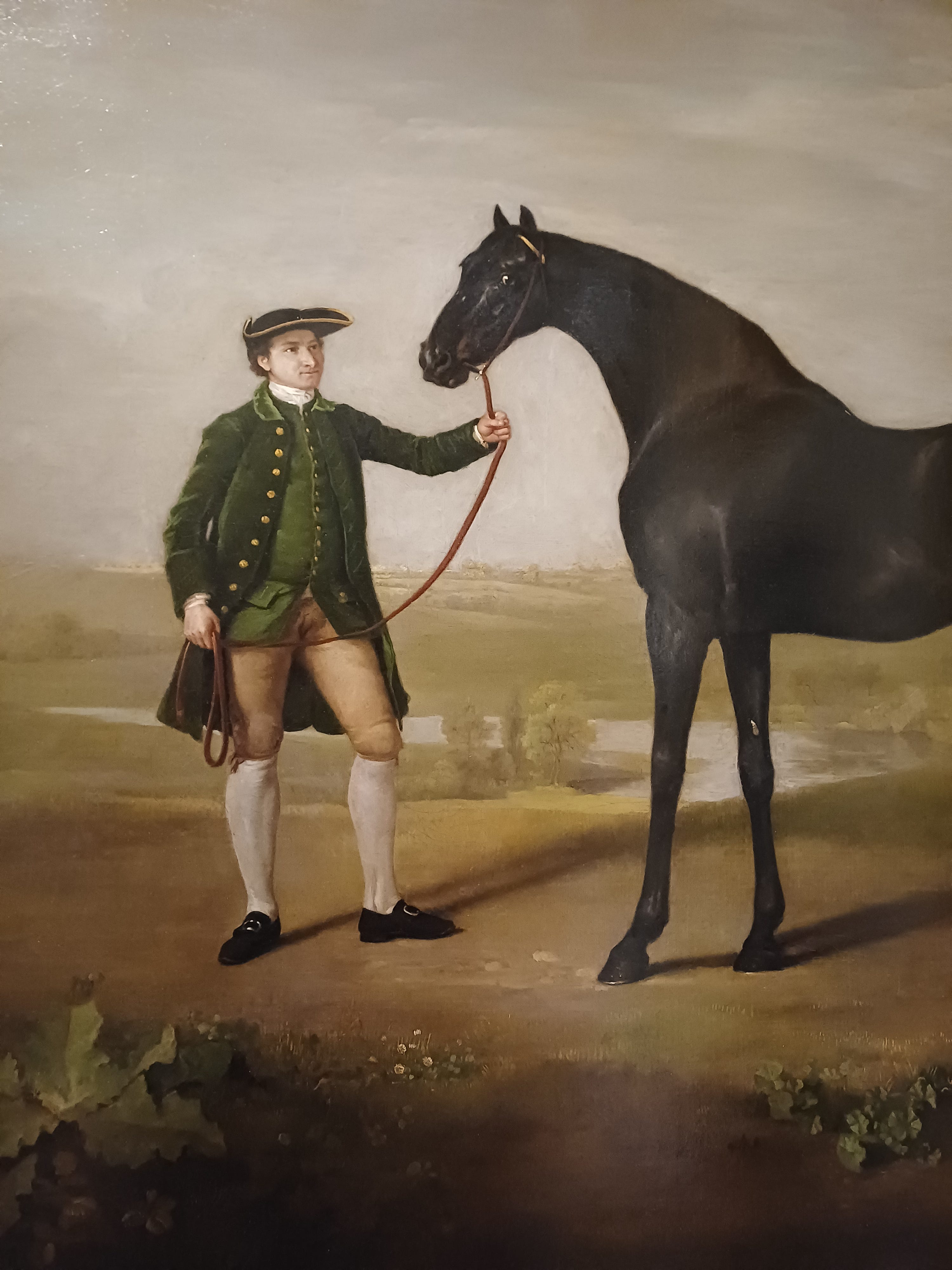
Nobody understood all this better than Stubbs, of course, and in Newmarket one can commune not just with horses but with his representations of them. A small collection of his paintings hangs at the British Sporting Art Trust, part of the wonderful National Horseracing Museum and housed in what was originally a wing of Charles II’s palace. The image below is from his 1762 painting of Snap (horses had names like that in the 18th century), a great-grandson of the Darley Arabian, from whom the majority of thoroughbreds, including my boy, are descended.
I read recently, and have no reason to doubt, that Larkin’s At Grass was ‘inspired’ (bit of a silly word) by a particular horse: Brown Jack, who died in 1948 and was quite possibly the most popular flat racehorse of the 20th century. Tractable and kindly, he was a six-time winner of the longest flat race in the calendar: the Queen Alexandra Stakes at Royal Ascot. On the day of his sixth appearance in 1934, the Evening Standard headlines read simply: ‘Brown Jack Today’. His jockey Steve Donoghue later wrote of the victory: ‘Never will I forget the roar of that crowd as long as I live… all my six Derbies faded before the reception that was awaiting Jack and myself.’
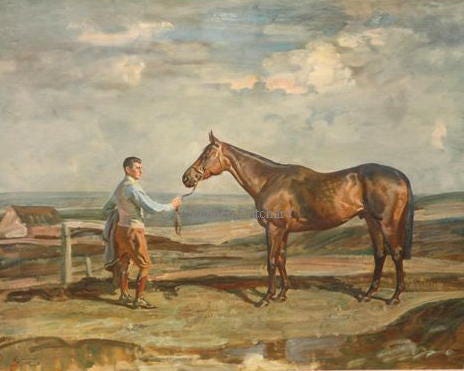
Brown Jack - painted here by Munnings - was ‘the people’s horse’. Not because of hype, some pre-ordained media-fabricated story, nor because the people who loved him had been told to feel that way. They just did. Racing today is obsessed with this kind of natural communion, which it paradoxically seeks to force at every turn: it longs for the days of Brown Jack, and it castigates the Epsom Derby for no longer being the race that stopped the nation, even though the industry itself has done so much to effect this decline.
Left to their own devices, spectators still feel adoration in the presence of the thoroughbred: the heart of the matter is still healthy. But the present-day racing industry is an arch-meddler, bothered no end by the fact that its chief practitioners cannot tell spectators what was going through their minds in the last furlong, and so fixated on selling to ‘new audiences’ that it does a superb job of alienating the audience it already has. The last time I went to Epsom, in 2022 on Oaks Day (ie today, when the fillies’ classic is run), the danger of getting coked-up by osmosis and the sight of a mysteriously demolished loo inside the Ladies’ - this in the most expensive grandstand - made me think: I really don’t want to go to this place that I love so much and hate it.
I used to write this kind of thing regularly in the Racing Post, being the only press-affiliated person who attended meetings as a normal paying customer; most people agreed with me but naturally one was not supposed to say any of it. Because racing is obsessed with crowds, and what they do when they get there is irrelevant as long as they are there.
Nevertheless, and what with Derby Day having been for so long my favourite day of the year, every autumn I announce that next year I shall definitely go back, yes, why not?!? I was fully revved up to be headed for Epsom tomorrow, thinking what did it matter about the drive for ‘change’ (rarely a good thing), what did it matter about the cokeheads and the champagne-inhalers, what mattered was the horses… Then I read this:
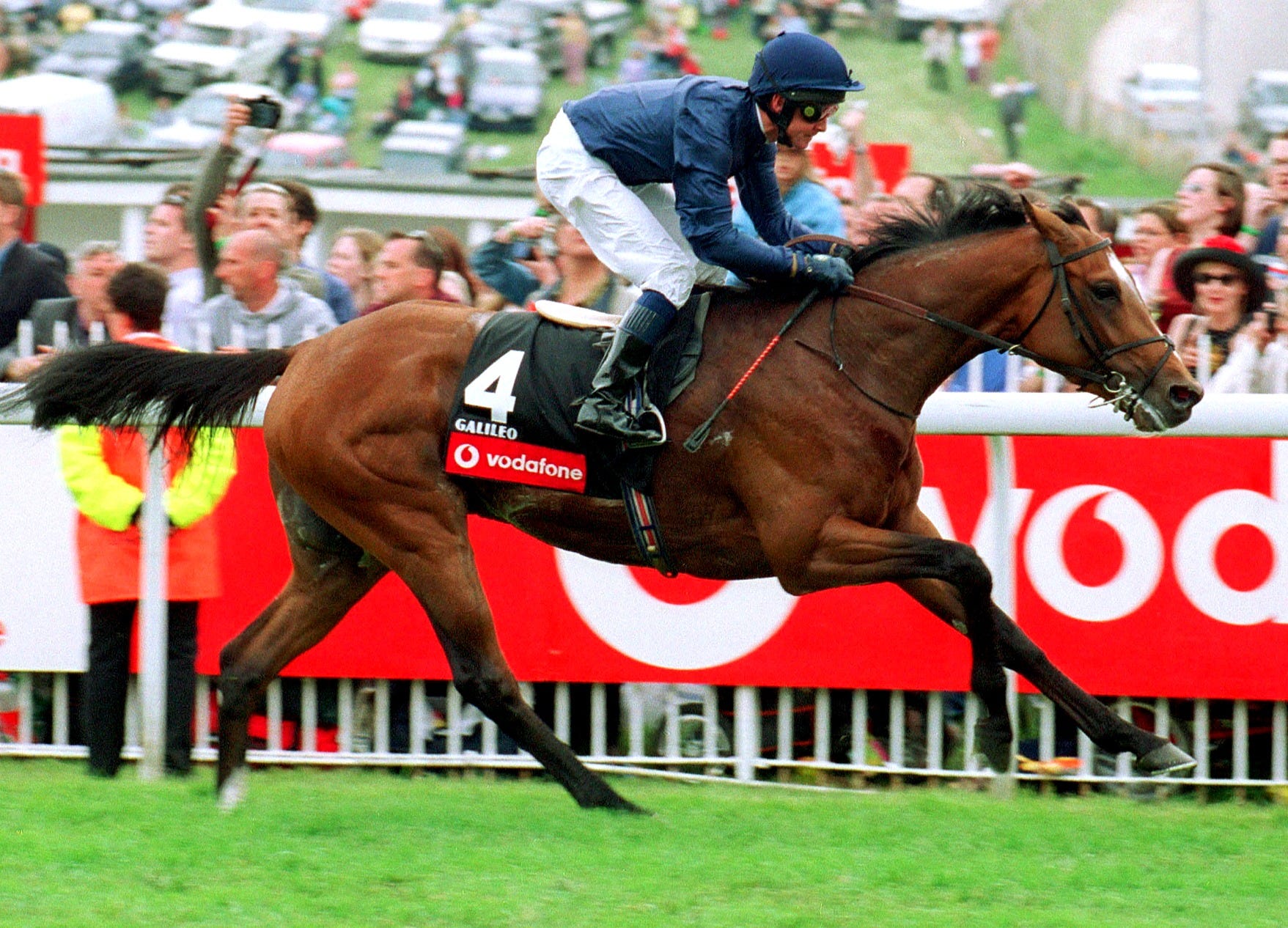
Named after the legendary 2001 Derby winner and record-breaking sire of five Derby winners Galileo, Galileo’s will be the new go-to space within the Grandstand Enclosure. The vibrant space will feature all-day DJs, live entertainment and a range of food and beverage concessions. Galileo’s will also be the new location of the official after-party across both days of the Betfred Derby Festival.
And I thought: no. Not least because Galileo, whose Derby victory I did see in person - I remember exactly what I was wearing, and can still feel the rush of joy that he conjured - is not a name to be taken in vain.
This, for tomorrow’s Derby Day, is now free to read.
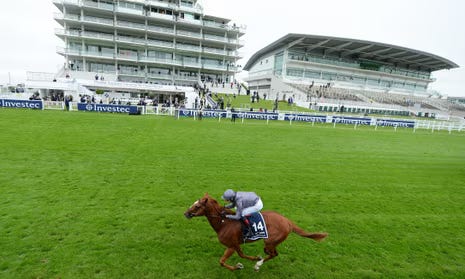
And a coda, about the image at the top of this piece, which represents the Epsom Derby won by a son of Galileo named Serpentine.
The race took place in 2020, thus in front of near-empty grandstands, in silence bar the drumming of horse hooves. ‘All I could hear was the horse breathing’, Serpentine’s jockey later said. The horse was a 25/1 outsider. Few people will have heard of him. He led pretty much all the way, in what looked more like an extended gallop than ‘the Derby’.
The victory of this horse - not entirely unexpected; one could never overlook a son of Galileo - was, nonetheless, greeted by the television broadcasters with a kind of sullenness within the emptiness. Who was Serpentine, and why had he created a whole new narrative that nobody had foreseen? If there were no crowds, could there not at least have been a horse who had been predicted to win, a satisfying continuation of a pre-ordained story?
But racing is not like that. I would have given anything to be at Epsom that afternoon. Serpentine’s silent victory had a power granted to no other Derby winner I have ever seen: pared back as it was to the essence, to the sight of a beautiful young animal running for a mile and a half around a bend and down a hill, doing the thing that he had been bred and designed to do, coming first among his equals at a particular moment in time, both here-and-now and semi-mythic, untrammelled by the paraphernalia that the industry has piled upon the sport.
It was ephemeral, and it was immortal. Essence of thoroughbred.
That Larkin poem is a wonder, even to a jump person like me. And the affinity one feels with the best of the best...I could never watch Desert Orchid run without a tear in my eye and I remember once going to see Pennwood Forge Mill (show jumper extraordinaire) in retirement and loving the calm, glossy fatness of him.
Oh dear God, how I agree with you. The best day of my life was watching Ray Cochrane FORCE Harry, a horse that hated to be in front, up the hill at Sandown to the finishing post and our first win. (Harry contrived to finish a close head in a two-horse race at Yarmouth.) The utter euphoria of that day will never leave me. Compare and contrast two years ago at the July course when I vowed never ever to go to a racecourse again.
I hate the electronic betting boards, the after-racing pop music from third rate bands, the over-emphasis on catering, the corporate hospitality — but most of all the idiots who decided that people would not just come for the beautiful beasts that are pivotal to the whole shebang.
I still watch flat racing on tv (like you I can’t bear the jumps) and still adore the horses and those who ride and train them. The rest can go bury their stupid heads in pints of prosecco and get their silly stilettos stuck in the turf. (Sorry, this has turned into a bit of a rant but it makes me so mad and so sad what racing has become.)