
Agatha
And the vagaries of reputation

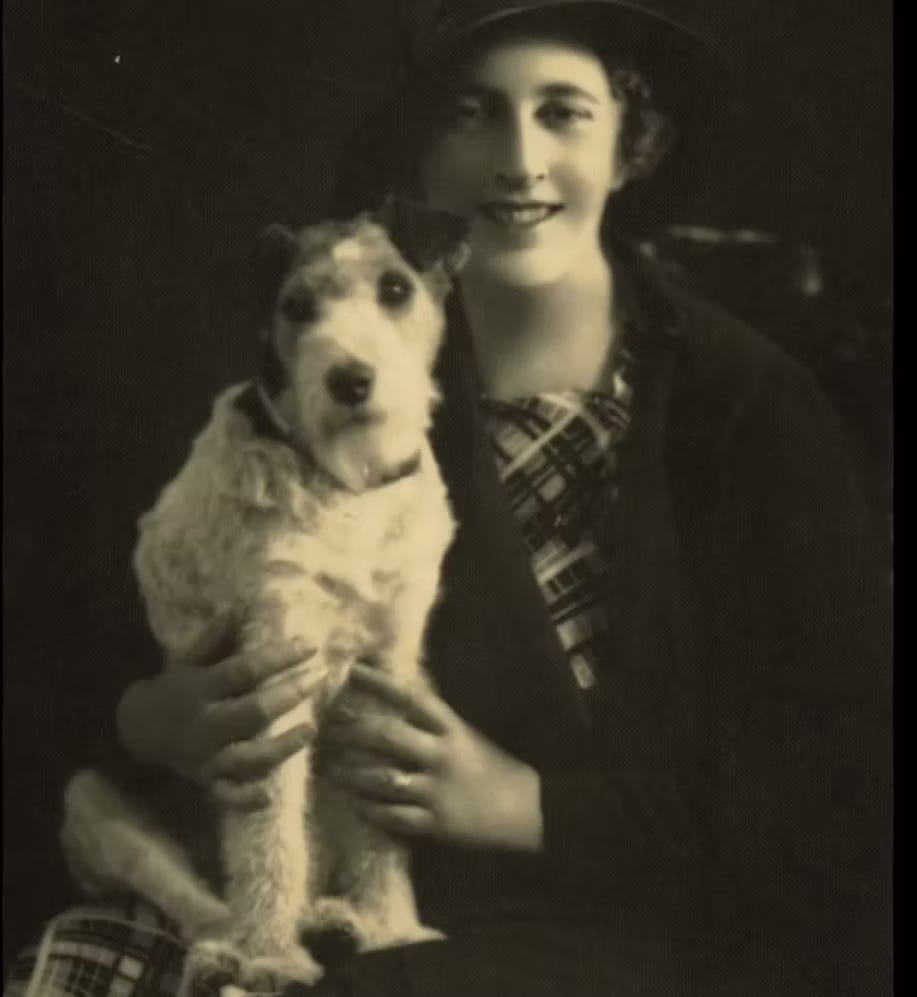
Back to my favourite subject. Today is my birthday, the same day as my wonderful mother, so if I delay acknowledging comments etc it will be because we are out doing shots visiting Ham House… unfortunately not quite the kind of magical spring day that has lightened life of late, and that blessed the unveiling of the new Agatha Christie statue at Torquay harbour.
Here she is, in bronze, with her dog Peter, the wire-haired terrier (Bob in Dumb Witness) to whom she clung through the horror year of 1926, culminating in the eleven-day ‘disappearance’, after the loss of both her mother and her first marriage in the space of five months.
‘My little friend and loving companion in affliction,’ as Agatha described Peter to her second husband. ‘You’ve never been through a really bad time with nothing in the world but a dog to hold on to.’
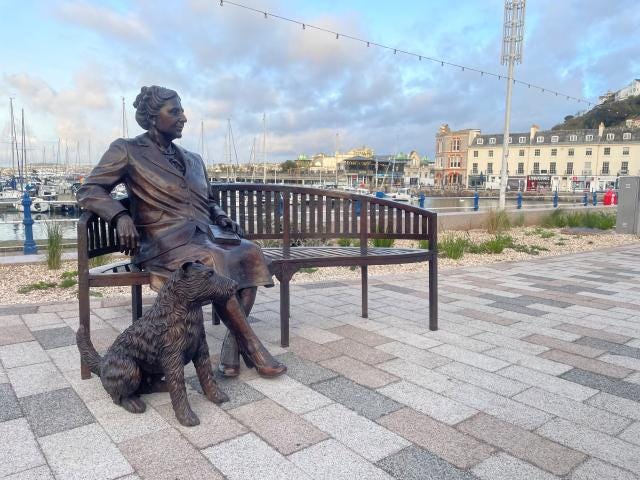
I like the statue, the second in the town where Agatha was born in 1890. It was revealed along with news of discussions to turn The Pavilion - by the harbour - into an Agatha Christie Research and Visitor Centre: ‘we hope this is the start of a new era of celebrating Agatha Christie to local, national and international audiences’, said the leader of Torbay Council.
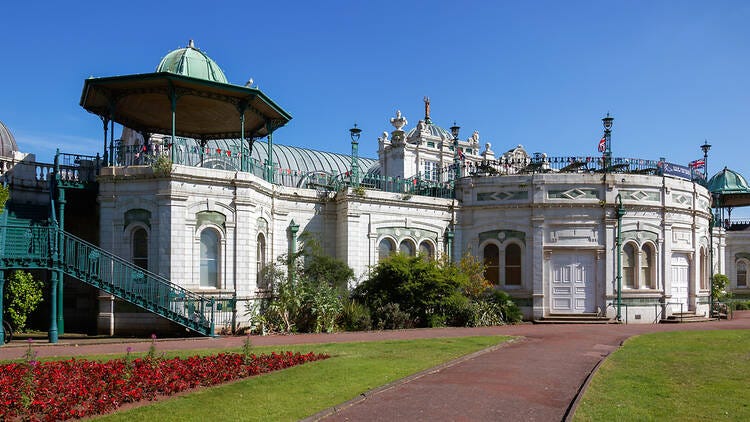
For as long as I can remember, The Pavilion has been boarded up and awaiting ‘development’ (the council reclaimed ownership at the end of last year). I did once go inside and could imagine how lovely it had been, when it was a concert hall and cinema, decorated with baroque curves and palm trees; the sight of it simply standing there is a symbol of the last century’s abandonment of the centre of Torquay, and indeed of so many once beautiful towns.
It opened in 1912, the year that Agatha met Archie. In my biography I wrote that they had gone to a concert at the Pavilion on 4th January 1913:
The music that night was Agatha’s beloved Wagner. The Pavilion was then newly completed, a fresh white and green building near the seafront. She and Archie sat beside each other beneath its domed skylight, their sleeves touching, listening to the music. Afterwards they went upstairs to the schoolroom at home, as Agatha put it in her autobiography ‘to play the piano’; then Archie turned to her with sudden fierceness and said, ‘You’ve got to marry me, you’ve got to marry me.’
So there is a certain rightness to the building’s re-imagining as an Agatha Christie Research and Visitor Centre; although something about that name, so corporate and oppressively generic, is at odds with the elusive, romantic image of the young woman among the palm trees, in the last year before Europe changed forever, sitting so close and aware with the man she loved so passionately (a part of her always would): a prelapsarian moment.
But Agatha is corporate now. She is a global brand, expanding like the universe itself, a phenomenon who holds her own easily in the franchise-loving twenty-first century. It has, moreover, become fashionable to admire her - celebrities eagerly confess their lifelong devotion; she is a subject of academic study, including a course at the Oxford University Department for Continuing Education. All of which I find richly comical, when I think of an interview that I gave, almost twenty years ago now on BBC radio, about the Agatha Christie biography that I was soon to publish.
The following - about the interview - is from the introduction to the book’s 2020 reissue.
… The presenter, plus a couple of crime writers, ganged up rather gleefully to inform me (as if for my own good) that Agatha was a fossil, a reactionary, a purveyor of puppet dramas twisted into a sham complexity. She was detached from reality – in every sense – and as shallow as a griddle-pan. Why was I seeking to praise this snobbish old dear?
When I could get a word in between the sneers and giggles, I asked why Christie was still so popular, if she was as dreadful as all that? A flurry of patronising responses ensued – ‘Oh well she’s quaint, she’s cosy, she’s clever at puzzles’ – and best of all: ‘Oh no, I love Agatha Christie, I just don’t think she’s any good!’
This ambush was intensely annoying, of course, but more than that it was boring. I had heard it all so many times before. These were the opinions with which I had grown up, those of the late twentieth century, shaped by the post-war changing of the guard and the intellectual snobbery that looked askance upon success. Since her death in 1976 Agatha Christie had become a name, an image, an English monolith like Nelson’s Column. The fact that she was also a creator – that her singular brain had at some point conceived the plot of Murder on the Orient Express, with which the world was as familiar as with the tune of ‘Hey Jude’ – had become almost incidental.
In other words, this supremely popular mega-selling author was taken for granted. Underrated, even. I think that I suspected as much from the first, aged ten, when I was drawn to the Tom Adams covers beside my mother’s bed and began to read Murder on the Links. An odd place to start – by no means one of her best – yet my reaction was akin to falling in love: much was incomprehensible, all was magical. I was told that these books were just whodunnits, to be read solely in anticipation of the end, but I never quite saw them that way. I always sensed something fablelike pulsing beneath the prose…. I smuggled them into university and read them metaphorically hidden, in the manner of an old-fashioned porn mag, within the pages of Beowulf. I was probably not the only person doing such a thing. But in the late twentieth century – when Agatha Christie’s reputation was low – it had to be kept secret, or made into a joke, even though I was convinced that only some sort of genius could cast this everyday spell.
I took her seriously, in fact, which was unusual until quite recently…
I shall refrain from naming the crime writers who did not take Agatha seriously, but they were certainly not outliers. The days when Val McDermid and Sophie Hannah would openly proclaim their informed admiration were still some way away. I have written previously about how P. D. James, whom I had the great pleasure of meeting for the book, placed many provisos upon her praise for Agatha (and did a truly hilarious takedown of the plot of Body in the Library); she also warned me not to bother speaking about Agatha to her friend Ruth Rendell: ‘Ruth hates her!’
Back to the biog.
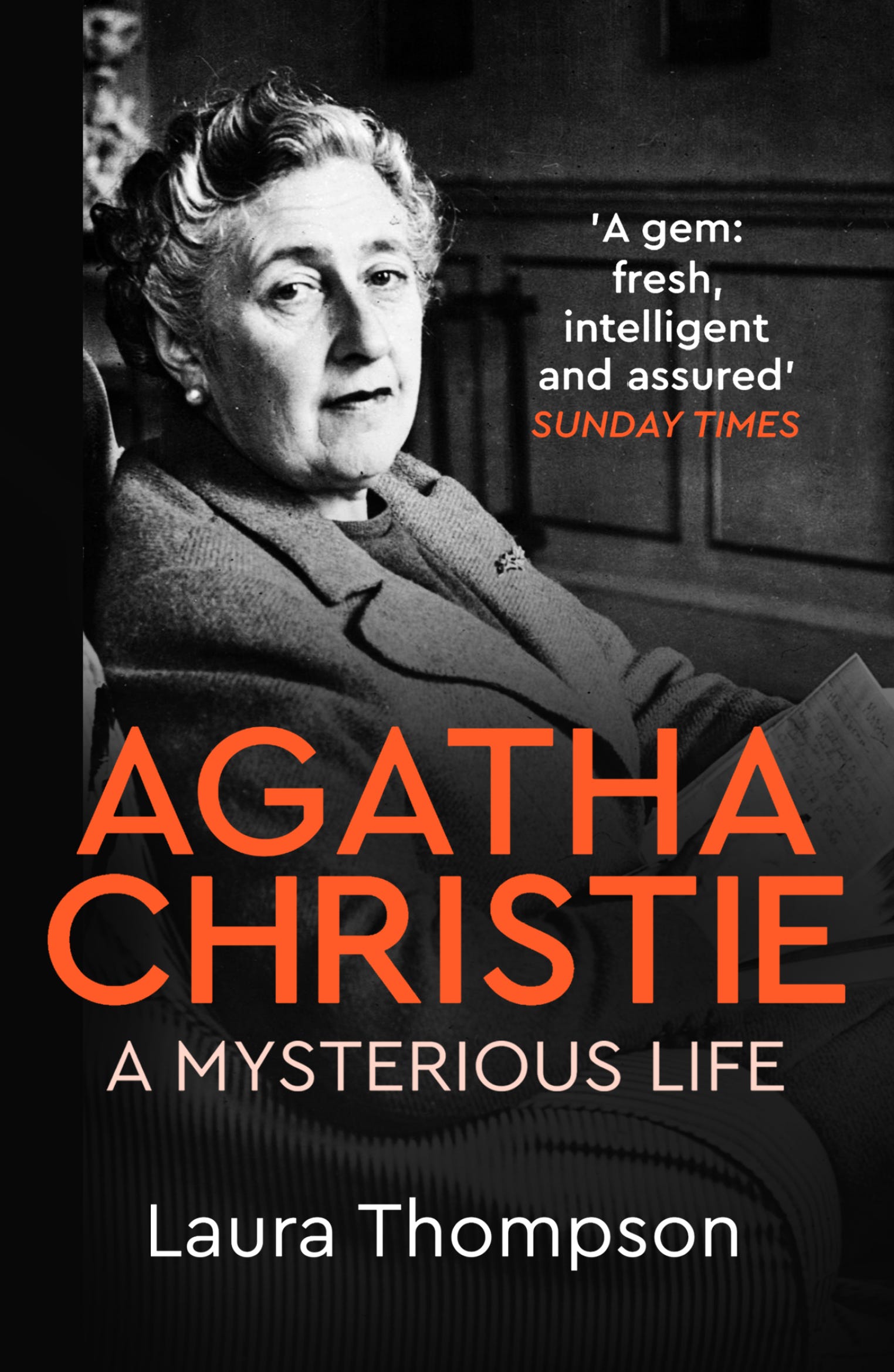
… Because of her facility – which nonetheless did not come easily – and her unusual clarity of exposition, Agatha Christie has been regarded as a craftsperson rather than a writer. She herself used this description in her autobiography. When she was awarded the CBE in 1956, she commented: ‘I feel it’s one up to the Low Brows!!’ But this was another example of the disingenuous persona that she adopted, very much at odds with the possessive pride in her work that she displayed in much of her correspondence with her literary agent. ‘I’m not just a performing dog for you all,’ she wrote in 1966. ‘I’m the writer.’
But it is as the performing dog that she is seen. ‘Who cares who killed Roger Ackroyd?’ was the famous question posed by Edmund Wilson in 1944, who wrote an essay dissecting the entire genre and – according to a Times column written by Bernard Levin in 1977 – ‘found not one of the books worth the time of an intelligent adult. Nor are they, for they are really nothing more than a verbal equivalent of those bent-steel puzzles in which the two bits of tangled metal look inextricably joined until you twist them so . . . when they come apart without further difficulty.’ Agatha Christie, wrote Levin, was the best of them, but such praise meant quite literally nothing. He would have agreed with Agatha’s ‘friend’ Robert Graves, who praised her books to her face and behind it stated that ‘her English was schoolgirlish, her situations for the most part artificial, and her detail faulty’.
There is a hint of envious misogyny in these criticisms. So too in this, from Raymond Chandler, who was irritated by Agatha Christie. And Then There Were None had been sold to him as ‘the perfect crime story’, but he found it full of impossibilities.
‘I’m very glad I’ve read the book because it finally and for all time settled a question in my mind that had at least some lingering doubt attached to it [he wrote to a friend in 1940]. Whether it is possible to write a strictly honest mystery of the classic type. It isn’t. To get the complication you fake the clues, the timing, the play of coincidence, assume certainties where only fifty % chances exist at most. To get the surprise murderer you fake character, which hits me hardest of all, because I have a sense of character . . .’
This became the accepted view of Agatha Christie, seized upon by other crime writers. According to Julian Symons, she wrote ‘riddles rather than books’. H. R. F. Keating said of her: ‘She never tried to be clever in her writing, only ingenious in her plots.’ Even admiration was expressed with a side order of reservations. In 1992 a Channel 4 television programme, J’Accuse, went a great deal further and expressed the view that Agatha Christie had murdered the genre, no less. She ‘was a killer, and her victim was the British crime novel’, as the writer Michael Dibdin put it.
‘Her aim was to fool the readers, and she sacrificed everything to achieve it. The plots in Christie’s novels were all basically the same – an ill-assortment of people gathered at an out-of-the-way place where a murder takes place. The characters were all generalized types. There were never any complex psychological characters. They were devoid of any emotional depth. Her books were artificially pure, and she ignored the problems faced by society.’
On the same programme, Ruth Rendell said: ‘When I read one of her books, I don’t feel as though I have a piece of fiction worthy of the name in front of me. With death, I do feel there should be an element of shock and horror and pain – but pain and passion aren’t there in Agatha Christie novels.’
Can you believe all this? How banal the criticisms? How sixth-form debating society, how spectacularly irrelevant? Can you believe the category errors that they commit, like attacking P. G. Wodehouse for not being Dostoevsky? ‘The problems faced by society’ indeed….
I find it astounding, this refusal to see that Agatha’s literary world is an artistic construct, not real but true, with a spare scenic immediacy that deals in geometry, not texture. The readiness to take her sublime simplicity at face value: to mistake simple for simplistic. Astounding, all of it, particularly the comments from Chandler, whose ability to miss the point is like somebody target-shooting in a blindfold after three martinis.
(Actually I have always thought Chandler somewhat overrated, if that isn’t playing him back at his own game; although I adore Ruth Rendell, who was also hellbent upon attacking Agatha for reasons that had nothing to do with anything).
That said: I do, sometimes, find the corporate nature of twenty-first century Agatha a bit much - the merching, the continuation novels, the riffs on her template, the spinning wheel of adaptations. I do, too, fear that I sometimes attribute a bit too much to her, analysing her highly particular genius as if it had an infinite capacity for analysis-absorption, a capacity that rightly belongs to a Shakespeare or indeed a Dostoevsky (but of course being clever about Agatha Christie is much easier). Nevertheless I am proud, deeply so, in having played my part in revising her reputation. I don’t read reviews but they do, by some undesirable process of osmosis, make their way back to one, and I know that some of the critics of my biography, when it was originally published in 2007, were snobbishly amused by the fact that I took my subject seriously, whereas those for the reissue entirely approved of that judgment. It had become the norm, just as it was once the norm to say that she wrote ‘animated algebra’.
This, in conclusion, is from that 2020 introduction.
… It is axiomatic that what is fashionable will become unfashionable, and the halo of cool that now shimmers around the white-haired matron at the vicarage tea party will eventually dim. She may revert to being ‘merely’ globally popular and immensely loved, beloved of text-analysing geeks and French intellectuals, mainstay of ITV3 and theatre touring companies.
Nevertheless I think that her value has been perceived; the weight of the monolith has been assessed: she will not, in my lifetime, retreat to being a joke.
There is so much in what you say, Laura, on the begrudgers of Christie's success: misogyny, other crime writers being patronising (& envious), a clubbish mentality (she's not one of us) and academic sneering. You have done a great job of giving Agatha her due, so well done. Hope you're having a very happy birthday.
This birthday treat is for your readers, when birthdays should be the other way round. But we accept with gratitude, given the sea of attitude that surrounds us. In my mind, critics and merch creators alike miss the point. They miss the spare staging, the geometry that compels as it does in any artistic first sketch, in which all that needs to be said is said. That first impression, that isn't ruined by excessive description.
But you, unlike them, get it.
Thank you, Laura, for this gift. Wishing you the happiest day!