
About a book
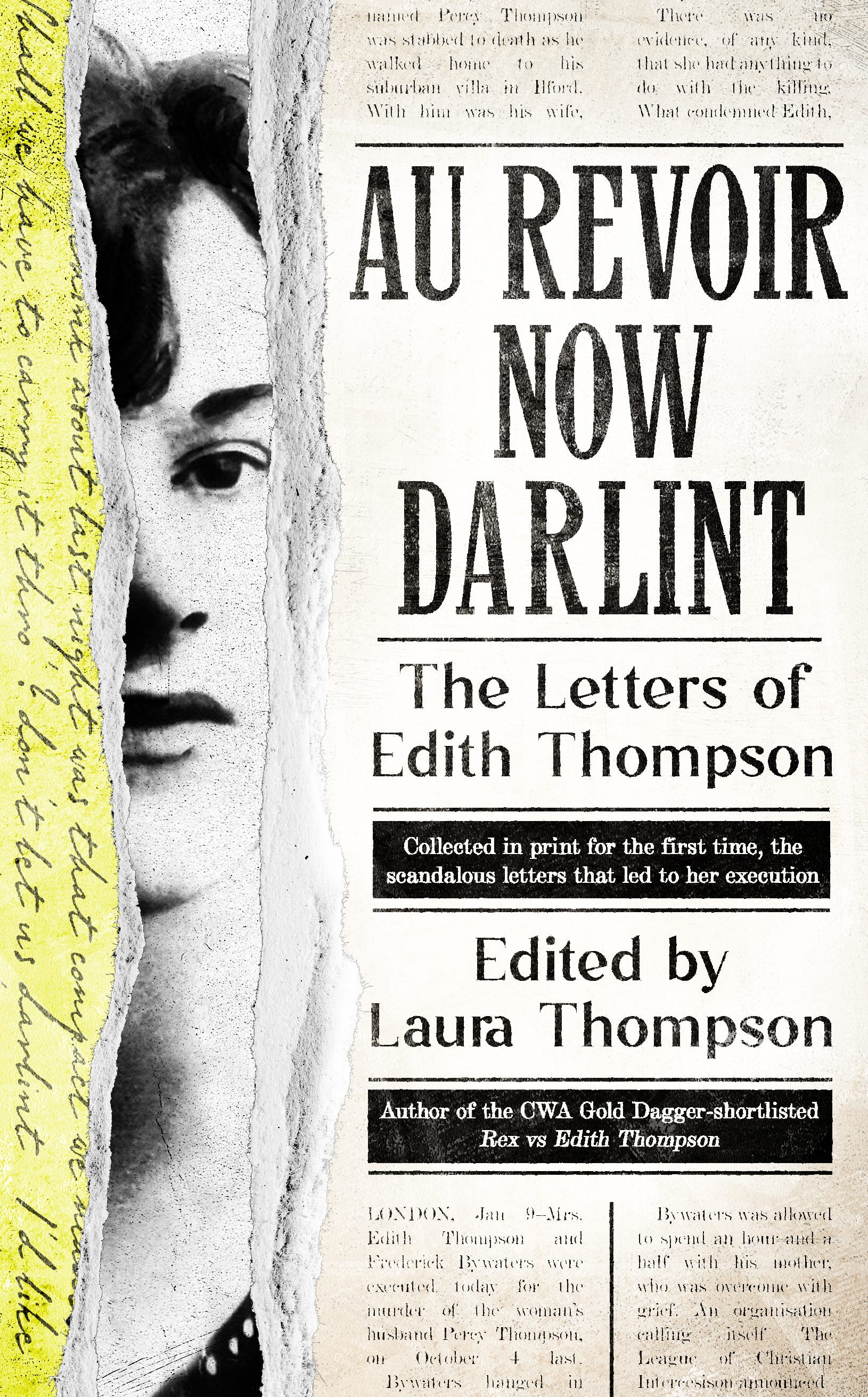
Au Revoir Now Darlint: The Letters of Edith Thompson

Those lovely subscribers who have stuck with me will know of my interest in - obsession with - a murder case from late 1922: the trial of Edith Thompson and Frederick Bywaters, for the killing of Edith’s husband Percy. A story both ordinary and extraordinary, in which three people died young and violently; a story about class, passion and the power of words. Most of all it is the story of a woman with an unusual personality and a writer’s gift, for which she had no real outlet. Today she would undoubtedly be on here with us. A century ago, her desire for self-expression led to those three deaths.
I have written two books about this case, which is often framed as a simple question of guilt v innocence but is, in fact, about the very nature of those concepts. It was Freddy who killed Percy, but did Edith’s words lead him to do it? If so, how guilty is she? Au Revoir Now Darlint, published for the centenary of the case, examines this question and lets the reader decide for themselves. It is an edited collection - plus commentary - of Edith’s letters to Freddy, the documents that would become evidence in her trial and that led to her conviction.
But the letters are also so much more than that: they are a record like no other of a woman’s life - and imagination - and as such they deserve publication in their own right. They are, if you like, Edith’s immortality. As I write in Au Revoir:
this book would not exist, and the name of Edith Thompson would be a mere footnote in an unmemorable murder case, if her lover Frederick Bywaters had done as she asked him, and destroyed her letters.
Au Revoir was an Unbound publication, and now the wonderful Wilton Square Books has taken it on - this has only just happened, but the book is available through Waterstones and on bookshop.org.
Any paid subscriber who would like a gift copy, just send me a message.
Having finished my book Eleven Days, although the dire saga of the Book from Hell continues (my God the story therein, a book in itself if ever I dared write it) I am back with my obsession, and a fourth draft script about Edith. People have been very nice about the scripts to date, but really that means little except that one is encouraged to continue - to vault the obstacle that commissioners place in one’s way, namely their antipathy to ‘Period Drama’ (although the most popular TV is, in the main, period drama).
Anyway, I just want to write it.
The publication of Au Revoir Now Darlint coincided with the most recent attempt (failed) to obtain a posthumous pardon for Edith, and I found myself talking about her on various media outlets, even Newsnight, proving that the power of the story had not diminished. So I am very pleased about Wilton Square. As a taster I have posted the introduction to the book - for which I have also done a one-take voiceover, including mistakes (not too many - which is lucky - as not a clue how to edit them out. Nor, apparently, how to pronounce ‘chiaroscuro’. I panicked).
Herewith the intro, and an image of the very much missed dedicatee.

To Milo, the darlingest boy
Letter to the Daily Telegraph, published June 1951:
On the direction of the judge about 120 typed foolscap sheets of the whole of Mrs Thompson’s correspondence were handed to the jury to be studied by them, and it was my duty to read them to the members of the jury, which included two women. ‘Nauseous’ is hardly strong enough to describe their contents…
The jury performed a painful duty, but Mrs Thompson’s letters were her own condemnation.
ONE OF THE JURY, London EC1.
From the closing speech for Edith Thompson’s defence, December 1922:
You have read her letters. Have you ever read… more beautiful language of love?
INTRODUCTION
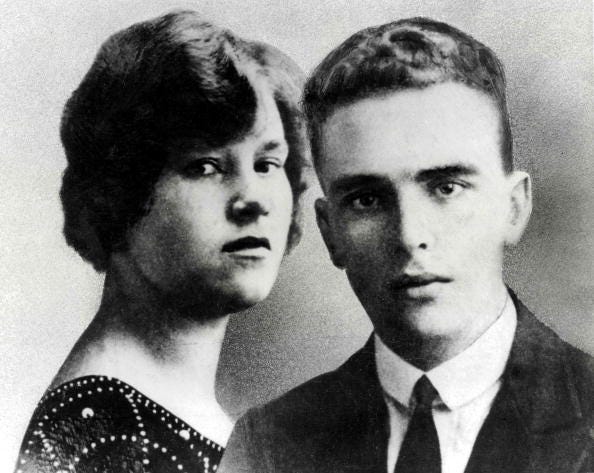
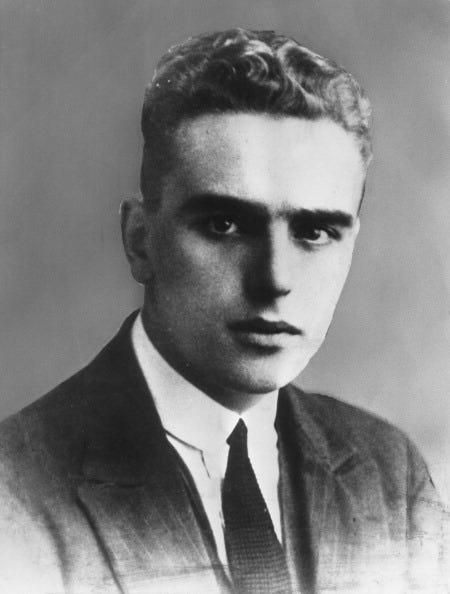
A hundred years ago, on the evening of 3 October 1922, a thirty-two-year-old man named Percy Thompson was stabbed to death as he walked home to his suburban villa in Ilford. With him was his wife, twenty-eight-year-old Edith. His killer was Edith’s lover: Frederick (Freddy) Bywaters, a merchant seaman aged twenty.
Freddy Bywaters was soon arrested, charged and tried. He was hanged at Pentonville on 9 January 1923. So too, a couple of miles away at Holloway, was Edith Thompson.
There was no proof whatever that she had anything to do with the killing of her husband, no material evidence of foreknowledge or complicity. What condemned her, essentially, were her own words: the letters that she had written to her lover, which were used by the legal system to ‘prove’ that she had conspired with Freddy and incited the crime.
The moral condemnation of Edith Thompson was not merely about murder, however. It was the fact that the letters were a prolonged celebration of an adulterous affair, with a man almost eight years her junior; a luxury add-on to a perfectly good husband, at a time when the First World War had left ‘decent’ women with no men at all. Moreover the letters portrayed pride, rather than shame, in love rather than marriage. And although they were, in fact, very little about sex, they were quite astonishingly sexy. Had they not been, people would not have been so ready to believe that they were also an exhortation to murder. It was a simplification to say, as Edith’s defence counsel would later do, that she was ‘hanged for adultery’; but at a time of great societal unease, not unfamiliar to us a century on, she became – in the totality of her transgression – a symbol of something that the nation wanted to purge. The idea of doing so was cleansing, restorative. ‘Even those who objected in principle to her execution can hardly regret her absence from this sphere,’ as a commentator put it in The Times. But plenty, as it happened, did not object to the execution.
A century ago, the content of the letters was what signified, although a handful of people saw them as remarkable in themselves. Now it is possible to see them as a record, perhaps unparalleled, of a woman seeking to vault the walls around her life and scale the twin towers of class and gender: an Everywoman who was also a supreme individualist, and who suffered an outlandish fate that might – in mitigated form – befall anybody who takes the wrong risks.
The letters were her great autonomous act, an attempt to release the self that had no other means of expression. But it is the way in which she does it, clear and direct and almost appallingly alive, that speaks across the years. Edith was a natural born writer. She left school at fifteen and had a taste for literature of the superior-popular kind, whose style would not have been a beneficent influence; but that was irrelevant because her style was entirely her own, and in fact not a style but a voice. Her sentences are shapeless and repetitive, in no way ‘correct’, yet some of them stick in the mind as correctness rarely can.
Darlint, I’ve surrendered to him unconditionally now – do you understand me?
We ourselves die & live in the books we read while we are reading them…
I just tried to make you live in my life…
He has the right by law to all that you have the right to by nature and love…
Darlint – do something tomorrow night will you? something to make you forget…
‘It is gush, it is not?’ said the judge at her trial, a voice from the pre-war era that she offended so profoundly. Even Edith’s supporter F. Tennyson Jesse, who in 1934 wrote a sympathetic novel based upon the case, A Pin to See the Peepshow, said that she had found the letters grating to her nerves – that she couldn’t take all those ‘darlints’: a contraction of ‘darlingest’. Edith’s signature word is, as much as anything, a punctuation to her sentences, which otherwise unfurl in stream-of-consciousness ribbons: the untutored kin of Ulysses with a pagan Lawrentian sensuality. Hers is a modernist voice, boneless and fluid, disdaining the formalities of grammar and snapping the shackles of morality. Freddy Bywaters had it right when he explained her thus: ‘When writing letters to me she did not study sentences & phrases before transferring them to paper, but, as different thoughts, no matter what, momentarily flashed through her mind, so they were committed to paper.’
Edith, who wrote to Freddy, was really writing for herself. Part of the appeal of this young man – her only extra-marital lover; she flirted indiscriminately but took love intensely seriously – was that he was hardly ever there. Fifteen months spanned the start of the affair in late June 1921 and its ending in early October 1922, and of that time the couple spent more than three-quarters apart. So the affair was epistolary, perforce; but the letters acquired their own importance, over and above her feelings for their recipient. And she believed, of course, that he was the only reader that she would ever have. She had no thought of being judged on what she wrote – not in a literary sense, and certainly not the literal sense applied by the No 1 court of the Old Bailey, where her letters were read to suit a particular end, the one that would kill her.
A century before the advent of cancel culture, this woman was cancelled – obliterated – for word crimes, thought crimes, the crime of being herself.
Edith Jessie Graydon was born on Christmas Day 1893. Her family was loving, warm, lower middle class – William Graydon was a clerk and part-time dance teacher, his wife Ethel a policeman’s daughter. Edith grew up in a tiny terraced house in Manor Park (now in the London borough of Newham) that she always thought of as home, and married at twenty-two because that is what young women did. So far, so ordinary. She read novels and became intensely involved in the lives of the characters, rather as today one might in a TV soap opera; she took immense pride in her home and her appearance; she relished London life, its bars and theatres; she suffered the terrors of ageing and of illicit pregnancy. Again, nothing extraordinary in any of this. She was typical, average, a figure one might recognize today, although in the early 1920s it was unusual that she worked throughout her eight-year marriage – as a highly efficient buyer and manageress in a City of London wholesale milliner’s, Carlton and Prior, where she was always known as ‘Miss Graydon’ – and earned more than her husband. The marital home at 41 Kensington Gardens, an attractive double-fronted property (slightly marred by the presence of the Lesters, a family of three sitting tenants), was registered in Percy Thompson’s name, as was then the norm. But Edith was its part-owner, her high achievements had helped to buy it, and hers was the taste that decorated it: a cabinet filled with Limoges in the drawing room, a mahogany suite with silk upholstery, ebony elephants, Japanese prints. She continued to work after her marriage, because that was what she wanted to do, and – most unusually – she had no children.
She enjoyed freedoms that her mother’s generation could not have imagined: no corset, no skirts trailing in the dirt, electric light in the home, rudimentary contraception, the prospect of the vote (although, as she died before the age of thirty, she never exercised that right). Much of this came about because of the First World War, when women worked, and thus had greater control over their bodies, their minds, their biological destinies. And these freedoms were not illusory; they were the beginnings of change; nevertheless they were revealed, when Edith’s life went wrong, to be fragile. Like so many women (this remains true today) she believed herself to have more power than she had. The years after the war, when jobs were handed back to men, were marked by a craving to return to the old certainties; Edith represented a future – and the kind of woman – that Britain feared. She became a scapegoat, hurled into the darkness. Not by blocking her on X or forcing her resignation. Literally.
Even now, Edith would be at risk of the rage of the mob. She did not ‘fit’; never the best idea for a woman, and especially not if she arouses perturbation rather than pity. She was aspirational, she was flighty, she was discontented, she was competitive, she was self-centred. Above all she was overwhelmingly attractive to men, a femme de l’homme, and this would still arouse the mixture of misogyny, envy and sanctimony that helped to bring about her downfall. She also possessed a capable business brain, which would get a better press today than a century ago; although the way in which she played up to her boss, Mr Carlton – rumoured to have paid for her expensive defence counsel – would assuredly be condemned by the Roundhead tendency.
Ours can be a prudish, prurient race, which struggles to treat sex in a grown-up manner. Faced with genuine erotic power, it can become censorious. All the more so in an age when marriage was for life and vamps were Theda Bara on the silent screen, not bob-headed girls walking the streets of Ilford.
Edith was sometimes beautiful, sometimes not; like her personality, her looks were protean; but her appeal was about more than that. Gender has become a construct, a choice. Yet nobody who reads her letters could honestly doubt that Edith was possessed of a lush and intrinsic femininity; that femaleness rippled through her genes, her flesh, her nature. She had, moreover, an irresistible quality of absorption, in life and her feelings about it, which she discovered and uncovered as her words tumbled on to the page.
In her letters she described her existence both as it was and how she wished it to be, and the two threaded in and out of each other, plaiting a pattern of truth and fantasy. The dream world that she conjured was one in which Percy Thompson did not exist. Her relationship with her husband was complicated, like everything to do with Edith. It is hard now to understand why she married him, and perhaps the surest sign that she knew she was not really free: that class decreed she should settle for a boy next door, who stood with her on the platform at East Ham Underground every morning on his dutiful journey to the City. He was in some ways her counterpart, a hard-working shipping clerk who had risen in life – in his case, from a deeply deprived childhood near the east London docks – and who had, at first, appreciated the specialness in his partner. In other ways he was hopelessly inadequate. Edith sometimes portrayed her marriage as dreary, sometimes as downright abusive. It may well have been both. Yet she did not leave Percy – admittedly a seismic step a century ago – and the couple socialized regularly together, including on the night of the murder, among people who considered them to be happily married.
In the letters, however, the yearning refrain was for a Percy-free future. Sometimes this theme played a darker variation, and became an avowed desire to eliminate her husband. Sometimes this variation was luridly coloured, with references to substances that she might add – or have added – to his food: poisons, pieces of lightbulb.
In fact it was Freddy Bywaters who killed Percy Thompson, solus and with a knife. The Thompsons were walking home from the train station after an evening spent watching a Ben Travers farce at the Criterion Theatre. They had almost reached their house when Freddy appeared as from nowhere. He stabbed Percy several times, three of the blows being deep and lethal, then ran off into the night.
It was never openly suggested that Edith played any physical part in the murder, although there were whispers – perhaps inevitably – that she had carried a small weapon and caused some of the minor cuts to her husband. The evidence for this is absolutely non-existent. The speculation arose only because of what she had written in the letters. They were the whole and the heart of it. Because of them she was tried, as was Freddy, for murder and conspiracy to murder; additionally she was charged with incitement, and with administering poison and glass with intent to murder.
In flat contradiction of this last indictment – and, indeed, of what Edith had written – her husband’s exhumed body was found to contain no trace of any injurious substance. After the post-mortem, a detective remarked that ‘the case against Mrs Thompson has failed.’
Yet it was pursued with quite extraordinary vigour, and its chief ally was the letters; although when their writer was asked to explain her own words, which was impossible because they had so little meaning outside her own head, the prosecution found that Edith Thompson herself was quite helpful too.
Murder writes human nature large; that is perhaps the essence of its fascination. In essence the Thompson–Bywaters case fits a familiar template, that of the eternal triangle (although there was, as will be seen, a shadowy fourth person in the mix). It also conformed to the Orwellian criterion of ‘classic’ English murder, wherein godless passions churn behind respectable facades. When Percy Thompson was stabbed, net curtains metaphorically twitched.
The case centres upon a love affair, and it says a great deal about the nature of romantic love. It deals in the whole question of illusion, without which romance cannot subsist, and in the solipsism that prevails within those who believe themselves to be inseparable from another person. Edith’s letters, which are like a continuous free-form poem, show her to have been semi-lost in a dreamscape, whose great delight was that she herself was conjuring it. It was as Flaubert wrote of Emma Bovary: ‘She was becoming a part of her own imaginings’.
From the outside one can see that she was also, more prosaically, an unsatisfied woman with an unsatisfactory husband, who started flirting deliciously with Freddy – another boy next door, a school friend of her younger brother Bill* – when he returned to Manor Park at the start of 1920, a few months before his eighteenth birthday in June. He had been on a tour with the SS Plassy, taking in China and Japan, having joined the merchant navy in February 1918, at the age of fifteen. Although extremely young he was, decidedly, a man.
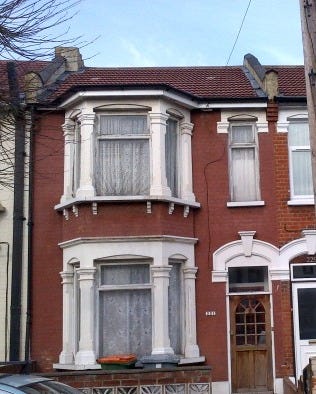
In May 1920 he moved into the Graydon family home, at 231 Shakespeare Crescent, as a paying guest. The Plassy was in dock at Tilbury, and Freddy’s widowed mother, Lilian,† had moved to Norwood in south London, so it was far easier to live eastwards. The Graydon house held other diversions, of course. During the eight weeks of Freddy’s first stay, he aroused the interest of the unmarried younger sister Avis – pleasant-looking, what would have been called a ‘nice girl’ – who became the object of his official attentions.
Unofficially his real inclination lay elsewhere, upon the star of the family: Edith. She, in her turn, was attracted. She was also unable to resist the occasional meeting with the young man whom her sister clearly adored.
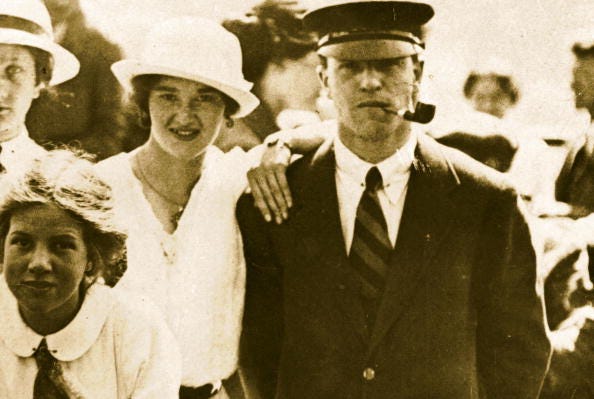
Thus things stood, in the relatively uncomplicated sphere of physical desire, not acted upon, with no danger in sight. Then, in June 1921, the two couples – the Thompsons, Freddy and Avis – holidayed in a boarding house on the Isle of Wight (the furthest afield that Edith ever travelled). A photograph taken during the journey, on the beach at Southsea, shows Percy reclining on a bed of pebbles, grinning into the camera with a pipe clenched between his teeth. Edith, beside him, openly cradles the head of Freddy Bywaters on her voluptuously raised hip. The photo, with its great erotic charge still pulsing through the dead chiaroscuro, prefigures all that would happen on this holiday.
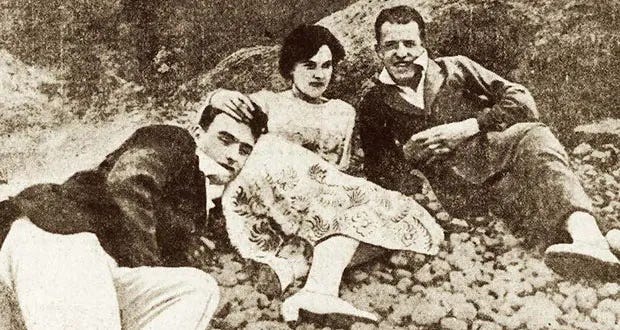
The person behind the camera – Avis – must have seen it; although she did not know for sure until the Thompsons left for London after a week and Freddy, who was supposed to stay on with her, trailed after them. She remained alone in the boarding house. When she returned to London, Freddy met her train and told her that he wanted to be friends, or some other time-honoured evasion. Yet she did not quite give up on him.
Percy, meanwhile, had seen nothing. Indeed his blissful ignorance was such that on 18 June he extended an invitation to Freddy to move into the Thompsons’ spare room, at the very reasonable cost of £5 a month. Nine days later, on Freddy’s nineteenth birthday, the lodger and the lady of the house became lovers.
Through late June and early July there ensued a sunlit honeymoon period, to which Edith’s letters would make frequent reference a year later.
Darlint this month and next are full of remembrances – arnt they?
Her second week of holiday was between 3–10 July, when the sitting tenants were away. During the days the lovers did as they wished: the illusion that the house belonged to them was only shattered when Percy turned his key in the front door. The Lesters returned, and Edith went back to work, but the affair continued to bloom in secret; until the afternoon of Monday 1 August, towards the end of the bank holiday, when a showdown between the parties created another prefiguring: of murder.
It began with an incident of ridiculous triviality. Percy, Edith and Freddy were in the back garden at the Ilford house; Edith was sewing and found that she needed a pin. Freddy offered to go into the house and get it for her. Something in the manner of Edith’s demand and Freddy’s response seems to have told Percy a part, at least, of what was going on. A quarrel began between husband and wife. It calmed down – started up again – then moved into that stage where all care and control is lost (the sitting tenants were out for the evening – had they not been, things might not have gone so far). Edith would later tell the Old Bailey that Percy hit her several times. According to corroborated evidence – Mrs Lester saw the black bruise down her arm – she was thrown across the room, overturning a chair and falling against a table. Freddy, who had sensibly remained outside, heard the crash and ran into the house as Edith fled upstairs. The two men squared up to each other, but Percy had no fear at all of his future killer. He demanded that Freddy leave, which he did immediately; clearing out for good on Friday 5 August.
Freddy’s reaction to Percy’s behaviour towards Edith, as described in a statement to the police, was characteristic. ‘I thought it a very unmanly thing to do and I interfered.’ He would make a similar remark with regard to the second confrontation, fourteen months later, a few yards from the house where he had spent that dangerously seductive idyll.
The reason I fought with Thompson was because he never acted like a man to his wife. He always seemed several degrees lower than a snake. I loved her and couldn’t go on seeing her leading that life.
As an analysis of his own motivation, it was deceptively simple. It certainly lifted any shadow of guilt from Edith Thompson. Yet it was she who created a killer out of a tangled string of words, even though the question of intent is what truly signifies. As does this: in the end, did the pair of them still believe that it had all happened because of love, or did they think that they had sacrificed themselves for not very much?
Edith Thompson, Everywoman, was defined by the desire to realize her extraordinariness. According to many commentators this was a self-delusion, which made her all the more ordinary: a Love Island contestant who dreams of walking the red carpet at the Oscars. Margery Fry, sister of the Bloomsbury Group’s Roger, and a notable penal reformer, visited Edith in Holloway and thought her ‘a rather foolish girl’. T.S. Eliot wrote to the Daily Mail to praise its cool reporting of the trial, ‘in striking contrast with the flaccid sentimentality of other papers I have seen’ (this was probably aimed at the Daily Express, whose editor, the future MP Beverley Baxter, was anti-death penalty and sympathetic to Edith).
Yet why did these high-end people bother to be dismissive, if the case – the personality of Edith – had not in some reluctant measure compelled them; as it did the ageing Thomas Hardy, who wrote a wretched poem about the ‘plain, yet becoming’ prisoner and her ‘Clytemnestra spirit’. Not for a moment was her guilt in question, but neither was the dense spell that she wove.
She was a cause célèbre, in fact, although it was Freddy who aroused most of the sympathy. Edith attracted fascination, but also blame. She was deemed, almost universally, to be the agent behind the murder, the puma who had compelled a besotted youth to do her killing for her. Again, the lack of evidence was overwhelming; but so too was the narrative. People subscribed to it in their millions, devouring pages of newsprint that knew exactly what to give them: the story of a wicked woman whose sins must be expiated for all our sakes. No man could possibly have aroused such powerful emotions as Edith Thompson did, this slim pale figure in her musquash coat, arriving at the Old Bailey like a doomed film star. Even now, a story that centres upon a female tends to be more compelling, more visceral in the response that it generates; even now, women touch nerves that a man cannot. Think Meghan. Think Blake Lively. Think of the careful path that female celebrity treads in order to keep the world onside, in order not to alienate: feminism and #metoo and all the rest notwithstanding.
Back in 1922, when Edith was condemned to be the first woman to hang for fifteen years, the equality argument was turned very smartly against her, in a way that is also familiar. Listen up, women, was the subtext of those advocating her execution. You campaigned to live like men, to vote and work and desert the home; you need to take the consequences and be judged like men. ‘If there was some plausibility before 1920 in the proposition that a woman’s sex disqualified her from suffering capital punishment,’ ran a letter in The Times, ‘there is none now.’
That was a male voice, discreetly revelling in a kind of puritan glee. And this – unlovelier still – was a woman’s voice, to the Home Secretary, after he refused to commute Edith’s sentence: ‘Thank you for defending the honour of my sex.’ There was more where that came from. ‘I do not think,’ wrote a Home Office civil servant, ‘we have a single application from any one of the women’s societies in favour of the reprieve of Mrs Thompson, and I believe that so far as those women societies are concerned any differentiation between these prisoners, purely on the ground of sex, or the respite of both prisoners on the ground that one of them is a woman and therefore if she is not executed the other ought not to be, would be bitterly resented.’
And the conclusion, to the vexed debate about executing a woman, was invariably this: given that young Bywaters had to hang, how was it fair that Edith Thompson should not? This was the outward, rational mood. Yet the secret, excited mood of the country held the reverse view: it wanted to hang Edith, and this meant that it also had to hang Freddy Bywaters.
Then, quite suddenly, it was all over. And a kind of unease began, almost instantly, to permeate a nation that had been so fervidly desirous of this particular cancellation.
I have been compelled by this story since my teenage years, drawn initially by the coincidence of the surname (there is no family relationship). As well as in factual accounts, it recurs as a cultural reference in several works of fiction. I first became aware of it in Agatha Christie’s Crooked House, a 1949 work through which the case runs like a motif. It is mentioned in Nancy Mitford’s Love in a Cold Climate, published the same year as Christie’s novel, in an ice-cool droplet that shows the perverse fame Edith had attained post-mortem. ‘I’m in a terrible do about my bracelet of lucky charms,’ says a woman who has suffered a jewel theft. ‘Just when I had managed to get a bit of hangman’s rope, Mrs Thompson too, did I tell you?’ But my fascination really flowered when I first read A Pin to See the Peepshow; a wonderful book to which I never return without longing for the story to play out differently, as it so easily could have done.
Forget the ends lose yourself in the characters and the story and, in your own mind make your own end. Its lovely to do that darlint…
With Edith Thompson, who sought to create her own story and – because of that – had it taken from her, the ending seems so random as to be unfathomable. A woman who could be so many of us, who could be me, who made mistakes and found that others were setting the price for them.
So much still resonates, beyond the ongoing dilemma of how to negotiate life as a woman. The instantaneous efficiency with which the ‘system’ enmeshes an individual and blocks every exit route. The incipient hysteria that turns upon certain categories of person and seeks their immolation. The prudery and judgmentalism within the national psyche. The terrifying manipulation of the concept of ‘truth’. The anger against words, and the wilful refusal to see nuance and ambivalence within them. Although the hanging of a twenty-year-old is a grotesque barbarism, Freddy Bywaters had at least committed a recognizable offence; but what happened to Edith is the stuff of Kafka, of show trials, of The Handmaid’s Tale… and, albeit in a different sphere, of the viciousness of internet culture, its howls against the very process of argument, its pathological hounding of those who have written the ‘wrong’ things. Prejudice changes with the times, yet it is always essentially the same; that is to say, resistant to reason.
Today the stakes are lower. But for those of us who are ambitious and foolish and – worst of all – unlucky, they remain in essence the same.
Thank you for reading.
A brilliant piece, and exceptional in making it so relevant to our lives today.
I still have my mum's copy of A Pin To See the Peepshow, which I read when I was in my early teens. I think there was a TV dramatisation of it around the same time that she and I also loved (could be wrong)?
How to negotiate life as a woman is an impossible 'how to'. Whereas other situations are considered 'win win' that is the opposite. Damned if one does, damned if one doesn't do... anything really!
Excellent piece. As always.